Baroque Ceilings, 125 Decibels: The Promoters Convincing Oxford's Heritage Venues to Stay Up Late
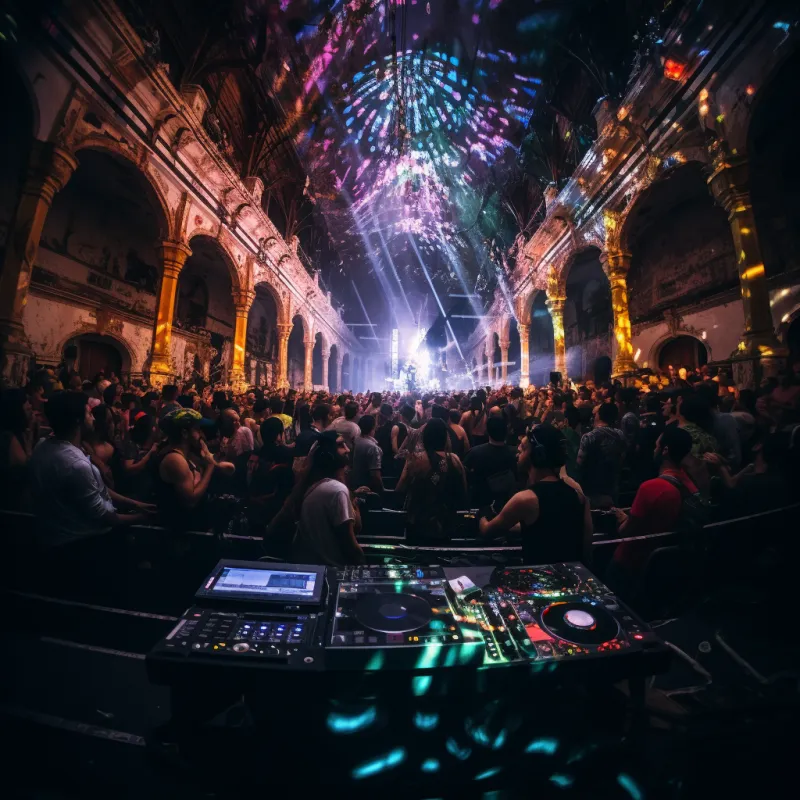
Photo: electronic music DJ performing in ornate historic hall with classical architecture, via assets.lummi.ai
There's a moment during every setup in the Sheldonian Theatre that promoter Ellie Farrow calls 'the wobble test'. A single low frequency, pushed through the rig at low volume, just to see what the building does. The chandeliers are checked. The 17th-century plasterwork is watched. Somebody from the facilities team stands with a clipboard, arms folded, waiting to see if history shakes loose.
'It's held up fine so far,' Farrow shrugs. 'But you don't find out by being brave. You find out by being boring about it.'
Boring, in this case, means months of emails, acoustic surveys, insurance documents thick enough to prop open a fire door, and a committee of dons who must all — eventually — say yes. It also means that on a handful of nights a year, one of the most architecturally significant rooms in Britain becomes a dancefloor. Not a themed one. A real one.
The Committee Is the Real Headliner
Ask anyone who's put on a night in a heritage venue and they'll tell you the same thing: the hardest part isn't the music, the crowd or even the licensing. It's the governing body.
Oxford's grandest rooms mostly belong to institutions — colleges, faculties, trusts — and each comes with its own ecosystem of stewards, conservators and resident committees. Some are enthusiastic. Some are deeply sceptical. All of them have questions.
'Every meeting starts the same way,' says one promoter who asked not to be named, mostly because he's got two more applications pending. 'They've heard about raves. They've seen things on the news from 1989. Your job in the first fifteen minutes is to convince them that what you're running is closer to a chamber concert with a better lights rig than a squat party in a warehouse.'
That means paperwork. Lots of it. Crowd management plans drawn up to the same standard you'd need for a graduation ceremony. Noise limiter figures modelled room by room. A documented plan for how you'll protect an original floor from 400 pairs of shoes — which, in practice, means protective sheeting, no heels policies in certain spots, and a bar layout designed so nobody's ever carrying a full pint across the valuable bit.
Fire Safety Maths and the 400-Person Question
The unglamorous arithmetic underneath it all is capacity, and it's brutal in old buildings.
A purpose-built club of equivalent floor space might hold 800. A listed hall with narrow doorways, multiple exit requirements, heritage fittings that can't be altered and escape routes designed for Victorian worshippers rather than festival crowds might legally hold 300. Sometimes fewer.
'You end up doing the sums backwards,' explains Farrow. 'You start from how many people can safely leave the building in ninety seconds, and that decides your ticket price. There's no economy of scale. You're running a small room at the cost of a big one.'
Add in the curfew — many institutional venues have hard stops written into their hire agreements — and you get a very particular kind of event: tight, curated, and over by midnight. Early finish, yes. But an early finish inside a building most Oxford students have only ever seen from the outside, or from the back row of a matriculation photo.
The Museum Lates Effect
None of this is happening in a vacuum. Across the UK, heritage venues are waking up to a demographic problem: the audiences who fill them during the day are ageing, and younger crowds — the ones who'll fund these institutions in thirty years — aren't walking through the doors voluntarily.
The solution, it turns out, is to meet them where they already are. Museum lates have been doing it in London for over a decade, and the model has trickled down: after-hours openings, DJ sets among the exhibits, electronic line-ups in rooms built for sermons and symphonies. For institutions, it's audience development with a smoke machine. For promoters, it's access to rooms money can't otherwise buy.
Oxford, with possibly the highest density of spectacular old buildings per square mile in the country, is a natural home for the trend. The city's club scene has spent years fighting venue closures and licensing pressure — so when the doors that do open happen to be architectural masterpieces, promoters are queuing.
What It Actually Sounds Like
Here's the bit that keeps everyone coming back, though, paperwork notwithstanding: the sound.
Old buildings were never designed for amplified music, and acousticians will tell you that's a nightmare — stone and plaster reflecting everything, reverb tails you could get lost in. But in practice, something stranger happens. A well-tuned rig in a vast, hard-surfaced room doesn't just play a track. It inhabits it. Kicks hit like they're arriving from all directions. Breakdowns hang in the air long enough to feel composed on the spot.
'People come up to me afterwards and can't explain why it felt different,' says Farrow. 'It's because you're hearing music in a room that took forty years to build. Your local venue took a weekend and a lick of black paint.'
There's also something quietly political about it, promoters argue. These buildings belong — in a loose, civic sense — to the city, and to the young people who live and study in it. Opening them after dark, with a soundsystem and a queue down the street, is a small act of redistribution.
Go If You Can
The nights are rare, they sell out fast, and they're rarely cheap — heritage overheads don't leave much margin. But if you get the chance to see a DJ play under a painted ceiling older than the concept of a nightclub, take it.
Just maybe leave the heels at home. The floor is 350 years old, and the committee will notice.